
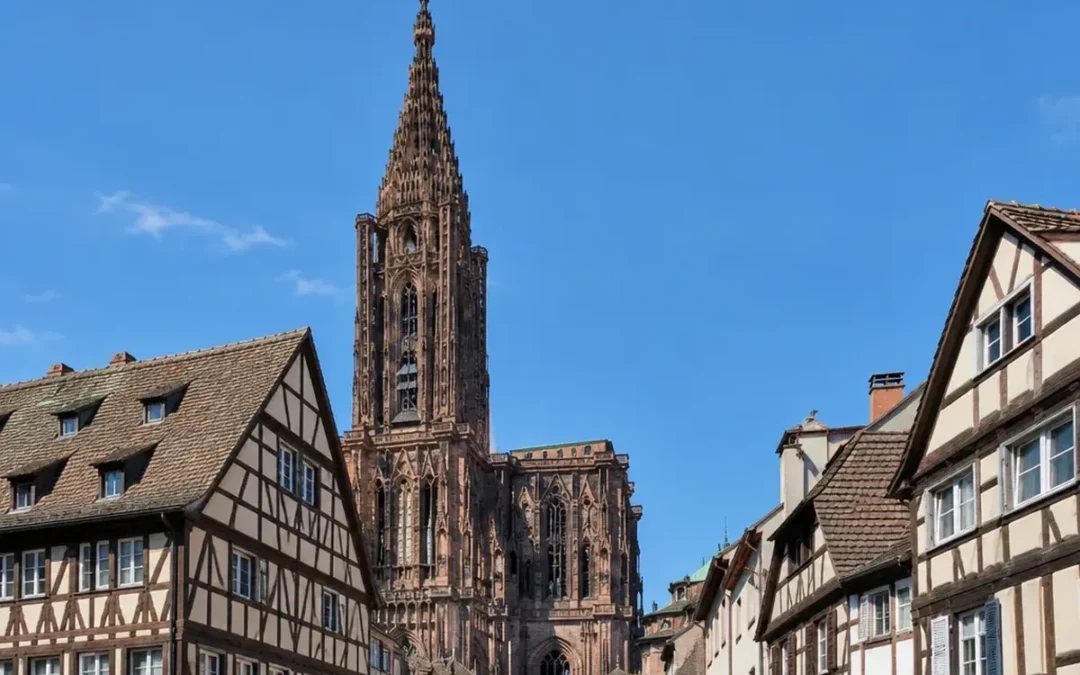
With its 142-meter spire, Strasbourg Cathedral is built entirely from pink Vosges sandstone, which gives the interior light a warm glow even on overcast days. The cathedral welcomes approximately 4 million visitors each year.
From Werner’s Foundation to a Gothic Masterpiece: The History
The cathedral rests on the foundations of an 8th-century Carolingian church. In 1015, Bishop Werner von Habsburg laid the cornerstone for a predecessor building. Following a fire, construction on the current cathedral began in 1176 at the choir and spanned nearly three centuries before reaching completion in 1439 with the spire.
Around 1225, master builders arrived from Chartres, introducing Gothic architecture to the Rhine. In 1277, work on the west facade began under Master Erwin von Steinbach, who oversaw construction until his death in 1318. The octagonal tower was erected between 1399 and 1419 by Ulrich von Ensingen, and in 1439, master builder Johannes Hültz from Cologne crowned the structure with its spire.
Since at least 1224, construction and maintenance have been guided by the Fondation de l’Œuvre Notre-Dame, which still employs stonemasons today. During the Reformation, from the 1520s until 1681, the cathedral served as a Lutheran place of worship until Louis XIV took Strasbourg and returned it to the Catholics. During the French Revolution, the building was temporarily converted into a Temple of Reason.
On March 2, 1941, during World War II, General Leclerc took the “Oath of Kufra” in Libya, pledging not to lay down arms until the French colors flew over the cathedral in Strasbourg. That pledge was fulfilled on November 23, 1944, at 2:20 PM, when the 2nd Armored Division under Leclerc liberated the city and raised the tricolor on the tower.
The Tallest Building in the World for 227 Years
Reaching a total height of 142 meters, Strasbourg Cathedral was the tallest building in the world from 1647 to 1874—a reign of 227 years. It gained this distinction after the spire of St. Mary’s Church in Stralsund burned down in 1647, and held it until St. Nikolai in Hamburg surpassed it in 1874. Today, it remains the sixth-tallest church in the world and the tallest surviving structure built entirely during the Middle Ages.
Its footprint covers 6,044 square meters, with a west facade measuring 51.5 meters wide. In 1988, UNESCO inscribed the cathedral alongside the surrounding Grande Île—the historic island connected to the rest of the city by 21 bridges and footbridges—onto the World Heritage list as the first French World Heritage site encompassing an entire historic center. The protected site was expanded in 2017 to cover 182 hectares, recognizing Strasbourg under Criterion (iv) as an outstanding example of a Central European city on the Rhine.
Inside the Cathedral: Stained Glass, the Pulpit, and Portals
The three west portals depict the Infancy of Christ on the left, Redemption in the center, and the Last Judgment on the right, including the depiction of the Tempter and the Wise and Foolish Virgins on the right. Victor Hugo called the cathedral a “prodigy of the gigantic and the delicate.”
Inside, the central nave reaches a clear height of 32 meters and a width of 16 meters. Key features include:
- The West Facade Rose Window: Measuring 14 meters in diameter, it was completed around 1345.
- Medieval Stained Glass Windows: Dating from the 12th to the 14th century, panels on the north side of the nave depict Holy Roman Emperors.
- The Apsis Stained Glass: The “Madonna of Alsace” window was created by Max Ingrand and donated in 1956 by the Council of Europe to replace the original destroyed in 1944 during World War II.
- The Flamboyant Gothic Pulpit: Created around 1500 for the preacher Johann Geiler von Kaysersberg, it features over 50 sculpted figures.
- The Choir and Rood Screen: In 2004, the marble furnishing of the choir and the rood screen were renewed by architect Jean-Marie Duthilleul.
- The Historic Great Bell: Cast in 1447 by Hans Gremp, the cathedral’s death bell (Totenglocke) weighs 7.5 metric tons and spans 2.2 meters across. An earlier bell cast in 1519 by Jerg von Speyer weighed 20 tons with a 2.74-meter diameter, but cracked shortly after installation.
The Astronomical Clock and the 12:30 PM Apostles Procession
The Strasbourg astronomical clock contains an estimated 30,000 mechanical parts. The present mechanism—the third clock built in the cathedral—was constructed between 1838 and 1843 by Jean-Baptiste Schwilgué (1776–1856), who received the commission 50 years after dreaming of repairing it as a boy. It replaced a second clock built between 1571 and 1574 by Conrad Dasypodius and the Habrecht brothers, which had succeeded the original 1352–1354 clock.
Schwilgué placed his movement inside the preserved 16th-century casing. The clock features a perpetual calendar equipped with a Gregorian computus for calculating Easter—presumably the first mechanical perpetual computus in history, drafted by Schwilgué in 1816. The clock displays a planetarium, true positions of the Sun and Moon, and solar and lunar eclipses. It is wound by hand every Monday by clockmaker (pendulier) Ludovic Faullimmel, who succeeded his father Alfred in 2001.
Daily at solar noon (12:30 PM), the automata perform a presentation lasting only a few minutes. A golden rooster—a surviving element from the 14th-century first clock symbolizing the Passion of Christ—flaps its wings and crows three times. The four stages of life (Childhood, Youth, Adulthood, and Old Age) parade past Death, followed by the Twelve Apostles processing before Christ, who blesses them.
To attend, visitors must purchase a separate ticket. An explanatory film in French, German, and English is screened at 12:00 PM before the automata move. The 12:30 PM procession does not take place on Sundays or public holidays (due to the 11:00 AM Mass), nor does it run during the Strasbourg Christmas Market (November 27 to December 24, 2026).
Climbing the 332 Steps to the Tower Platform
Visitors can climb the spiral staircase to the viewing platform at the base of the spire. Situated 66 meters above the square, the platform offers panoramic views that stretch on clear days from the Vosges to the Black Forest.
The climb consists of between 330 and 332 steps with no elevator, making it unsuitable for visitors with reduced mobility. Along the ascent, visitors pass two medieval 15th-century treadmill hoists (“squirrel wheels”). At the platform, an augmented reality station (VR Strasbourg Cathédrale) displays views of the city as it appeared in 1490 and 1730.
Visiting Strasbourg Cathedral: Practical Guide and Costs
Admission to the nave of the cathedral is free of charge and requires no reservations. Tickets for the tower platform and the astronomical clock show must be bought in person on the day of your visit; online booking is not available.
| Section / Attraction | Standard Admission | Reduced Admission | Opening Hours |
|---|---|---|---|
| Cathedral Nave | Free | Free | Mon–Sat: 8:30 AM–11:15 AM & 12:45 PM–5:45 PM Sun & Holidays: 2:00 PM–5:15 PM |
| Astronomical Clock Show (12:30 PM) | €4 | €3 (students up to 25, groups of 12+) €2 (ages 6–17) Free under 6 |
Film at 12:00 PM; procession at 12:30 PM (Tickets sold 10:00–11:00 AM at cathedral shops; from 11:30 AM at Saint-Michel entrance on Place du Château) |
| Tower Platform Climb (332 Steps) | €10 | €6 (ages 6–18, students, Eurométropole staff) | Apr 1–Sep 30: 9:30 AM–1:00 PM & 1:30 PM–8:00 PM (last climb 7:15 PM) Oct 1–Mar 31: 10:00 AM–1:00 PM & 1:30 PM–6:00 PM (last climb 5:15 PM) |
- Midday Nave Closure: On standard days, the cathedral closes between 11:15 AM and 12:45 PM to visitors so the clock presentation can take place.
- Time Allocation: Allow 45 minutes to 1 hour to explore the nave. Budget 2.5 hours if combining the nave, platform climb, and clock show.
- Best Time to Visit: The quietest time to visit is at 8:30 AM when the cathedral opens. In summer, the platform climb is best undertaken in the morning, as the spiral stairwell becomes extremely hot in the afternoon.
- Dress Code and Etiquette: Men are asked to remove hats inside the church. The cathedral provides details on its expected dress code on its website.
- Accessibility: Visitors with reduced mobility can enter the nave via a side ramp. The tower platform and clock area are not accessible.
- Christmas Market Schedule: During the Christkindelsmärik (November 27 to December 24, 2026), the nave remains open continuously Monday through Saturday from 8:30 AM to 5:45 PM, though the clock show does not run. The market on Place de la Cathédrale operates daily from 11:30 AM to 9:00 PM across eight locations on the Grande Île.
Common Misconceptions About Strasbourg Cathedral
- Myth: A southern tower was destroyed or collapsed.
Fact: The cathedral’s asymmetrical silhouette with only one northern tower exists because the planned south tower was never built. - Myth: The astronomical clock seen today is completely medieval.
Fact: While the external casing dates from the 16th century (1571–1574) and the rooster from the 14th century, the mechanism of approximately 30,000 parts was constructed by Jean-Baptiste Schwilgué between 1838 and 1843. - Myth: You can buy tickets online in advance to skip the line.
Fact: There is no online booking for entry, the platform, or the clock presentation; all tickets must be purchased on site on the day of the visit. - Myth: The pink coloring is artificial or caused by aging.
Fact: The building is constructed entirely of pink Vosges sandstone, which gives the interior light a warm hue even on overcast days.
Frequently Asked Questions
What is Strasbourg, France known for?
Strasbourg is the capital of the Bas-Rhin department in the Grand Est region and the seat of the European Parliament, the Council of Europe, and the European Court of Human Rights. It is also known for its UNESCO-listed Grande Île, its Christmas market dating back to 1570, and as an outstanding example of a Central European city on the Rhine.
How close is Strasbourg to the German border?
Strasbourg lies approximately 4 kilometers west of the Rhine, which forms the border between France and Germany. The German city of Kehl lies directly opposite across the river.
Is it free to go to Strasbourg Cathedral?
Yes, admission to the cathedral nave is free of charge and requires no reservations. Paid tickets are required only for climbing the tower platform (€10 standard, €6 reduced) and attending the astronomical clock presentation (€4 standard, €2–€3 reduced).
What is Strasbourg Cathedral known for?
The cathedral is known for its 142-meter spire—which made it the world’s tallest building for 227 years—its pink Vosges sandstone construction, 12th- to 14th-century stained glass windows, and its 19th-century astronomical clock with its automated Apostles procession.
What can you see and do at Strasbourg Cathedral?
Visitors can tour the nave, view the 14-meter rose window and the pulpit by Johann Geiler von Kaysersberg, attend the 12:30 PM astronomical clock show, and climb 332 steps to the 66-meter platform for views extending from the Vosges to the Black Forest.
Do you need to book tickets or a tour to visit Strasbourg Cathedral?
No. There is no online booking for the cathedral, the platform, or the clock show. Entry to the nave is open without reservations, and tickets for the platform and clock presentation are sold exclusively on site on the day of the visit.