
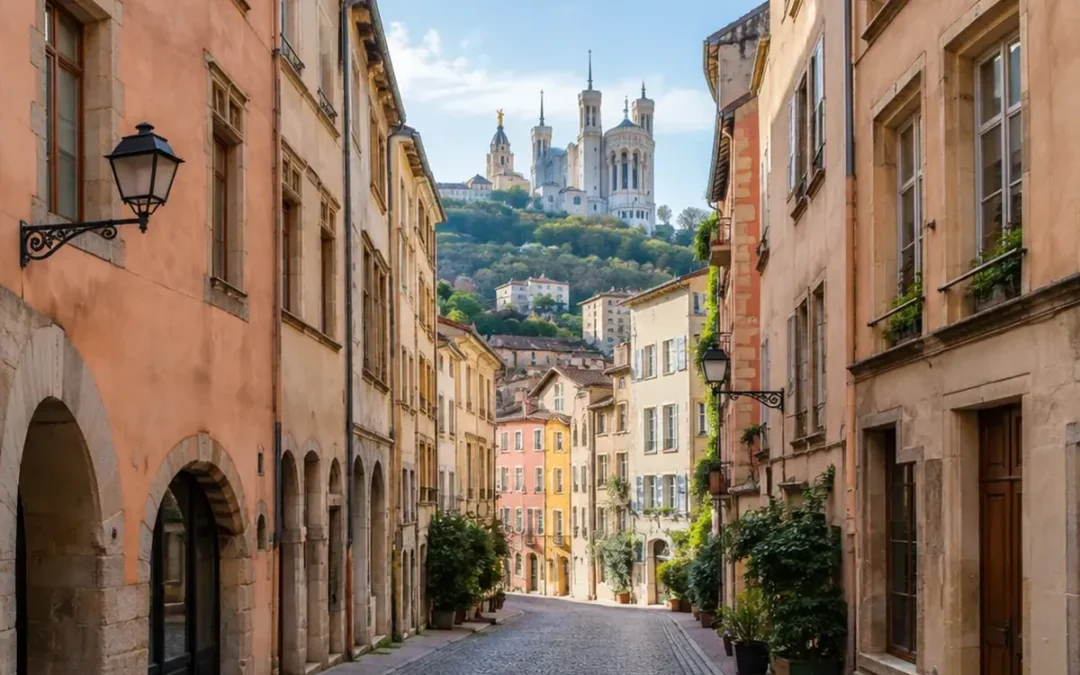
Vieux Lyon is one of Europe’s largest Renaissance ensembles, unfolding across 24 hectares along the western bank of the Saône River beneath Fourvière hill. Often referred to simply as the old town, this district is famed for its network of hidden corridors known as traboules, grand interior courtyards, and traditional culinary taverns called bouchons.
The History and Architecture of Vieux Lyon
The history of the district dates back to the ancient Roman settlement of Lugdunum, founded in 43 BC as the capital of Gaul. Over centuries of urban continuity, wealthy Italian, German, and Flemish merchant and banking families built residences here during the 15th and 16th centuries, giving old Lyon its distinctive architectural imprint of stone arcades, spiral staircases, and ochre tones.
The neighborhood was protected under the 1964 Malraux Law and its conservation plan (Plan de Sauvegarde). On December 5, 1998, a 427-hectare area representing 10% of the city of Lyon was designated a UNESCO World Heritage site under criteria (ii) and (iv). Within this protected perimeter—which also covers Fourvière, the Croix-Rousse slopes, and the Presqu’île—stand 162 listed historic buildings supporting roughly 60,000 residents.
Vieux Lyon is divided into three distinct sectors along the Saône:
- Saint-Georges: The southern quarter.
- Saint-Jean: The central district, home to the cathedral.
- Saint-Paul: The northern quarter.
Secret Passageways: How to Visit the Traboules
The word traboule derives from the Latin phrase trans ambulare, meaning “to walk through.” Originally, around 400 of these passageways and courtyard corridors were constructed across the city. In the Middle Ages, they served as quick shortcuts to the boats on the Saône River, and later served the French Resistance as covert transit routes during World War II.
Today, roughly 50 courtyards and traboules remain freely accessible to the public between 7:00 AM and 7:00 PM across the old quarters. To locate them, pick up a free map at the Lyon tourist office on Place Bellecour. Because these corridors run through private residential properties, visitors are expected to observe quiet hours and keep voices low.
Two essential routes to seek out include:
- The Longue Traboule: The longest interior route in the district, running from 54 rue Saint-Jean straight through to 27 rue du Bœuf. It crosses four separate courtyards and four buildings.
- The Renaissance Gallery Passage: Connecting 27 rue Saint-Jean to 6 rue des Trois-Maries, this restored passageway features a two-story 16th-century gallery finished with pale plaster.
Must-See Sights: Cathédrale Saint-Jean and the Tour Rose
Standing in the center of the district, Cathédrale Saint-Jean-Baptiste (known locally as the primatiale) was erected between 1175 and 1481. Combining a Romanesque apse with a Gothic facade, it features roughly 300 sculpted stone medallions, alongside a rose window completed in 1392. Historically, this cathedral witnessed the 1316 coronation of Pope John XXII, the 1600 royal wedding of Henri IV and Marie de’ Medici, and Cardinal Richelieu receiving his cardinal’s hat in 1622.
Inside stands an astronomical clock measuring 9.35 meters tall and 2 meters wide. First documented in 1379 and rebuilt in 1598 by Hugues Levet and Johannes Lippius before finishing in 1660, it is the only clock in France to have preserved its original 14th-century medieval mechanism. At noon, 2:00 PM, 3:00 PM, and 4:00 PM daily, an ensemble of 19 automated figures animates to enact the Annunciation.
A short walk away at 16 rue du Bœuf sits the Maison du Crible and its famous Tour Rose. This spiral staircase tower rises from a Renaissance courtyard framed by galleries and arches. King Henri IV lodged in this mansion in 1600 during his wedding festivities. Today, the building houses residential apartments and an Orthodox chapel, while the courtyard remains open to daytime visitors.
Dining in a Traditional Bouchon Lyonnais
A true bouchon is a traditional tavern marked by personal hospitality, red-and-white checkered tablecloths, and hearty culinary heritage. The word likely originated from the straw bundle (bousche) that early tavern keepers hung above their doors as an inn sign, or from the grooming of horses (bouchonner). In the 19th century, female cooks known as Mères lyonnaises, such as Mère Fillioux and Mère Brazier, defined this style of cooking.
Because tourist areas draw generic imitations, look for the yellow plaque bearing the puppet figure of Gnafron. Awarded by the Les Bouchons Lyonnais association following independent audits, this seal marks about 20 certified establishments, including spots like Daniel & Denise Saint-Jean.
Classic dishes to order include:
- Salade lyonnaise: Green salad served with bacon, croutons, and a poached egg.
- Quenelle de brochet: Pike dumpling served in crayfish sauce.
- Tablier de sapeur: Breaded beef tripe.
- Tarte aux pralines: A sweet pastry crust filled with pink praline cream.
Where Anthony Bourdain Ate in Lyon
In Season 3, Episode 3 of Parts Unknown (2014), Anthony Bourdain traveled across the city to explore its status as the world capital of gastronomy, an official title Lyon has carried since 1935.
His culinary itinerary covered several iconic addresses:
- Café Comptoir Abel (25 rue Guynemer): One of the oldest traditional eateries in the city, where Bourdain sampled baked quenelle de brochet en gratin.
- Reynon (13 rue des Archers): A classic charcuterie where he tasted sabodet, a sausage made from pig’s head, tongue, and beef.
- Café Comptoir Brunet (23 rue Claudia): Where he drank local Beaujolais and ate traditional blanquette de veau alongside the Francs-Mâchons.
- Institut Paul Bocuse: Joining chefs Viannay, Viola, and Ducasse to share poulet en vessie, whole chicken poached inside a pig’s bladder.
- Restaurant Paul Bocuse (40 rue de la Plage): Bourdain dined on the black truffle soup V.G.E. and sea bass baked in puff pastry crust (loup en croûte feuilletée).
Planning Your Visit: Transportation, Funicular, and Timing
A standard half-day visit of three to four hours covers the main sights, while a full day provides time to explore the traboules and ride up to Fourvière.
The entire district is paved with cobblestones, so flat walking shoes are recommended. To get here, ride Metro Line D directly to the station Vieux Lyon – Cathédrale Saint-Jean. Alternatively, cross the Saône on foot from Place Bellecour across the Pont Bonaparte in roughly ten minutes.
From the metro station concourse, board the historic F2 funicular railway (locally nicknamed the “Ficelle”). Operating since 1900, the two single-car trains carry up to 70 passengers each, climbing 116 meters in altitude across 427 meters of track in two minutes. A single TCL transit ticket (costing 2.10 €) is valid for the journey, including transfers within one hour and round trips, while dedicated funicular return tickets cost approximately 3.60 €. An efficient touring strategy is to take the funicular to the top and then take the 25-minute walking descent back through the Jardin du Rosaire.
Lyon vs. Nice: Choosing Between Two French Destinations
Travelers planning a broader journey through France often weigh an inland stay in Lyon against a southern vacation in Nice. Both offer distinct regional appeal depending on travel priorities:
| Travel Factor | Lyon | Nice |
|---|---|---|
| Primary Focus | Culinary heritage, bouchon dining, and historic architecture | Mediterranean coastline, seaside walks, and resort leisure |
| Daily Mid-Range Budget | $100 to $160 per day | $110 to $170 per day |
| Best Travel Windows | April to June; September to October | May, June, and September |
| Crowd Atmosphere | Cultural depth with fewer tourist crowds | Classic French Riviera atmosphere with larger resort crowds |
Common Myths and Misconceptions About Vieux Lyon
Several frequent misunderstandings circulate about the district’s monuments, history, and food culture:
- The Tour Rose was always pink: The tower’s pink shade likely dates back to the 1970s. Earlier historical records make no mention of a pink facade.
- Cervelle de canut contains animal brains: While the name translates to “silk worker’s brain,” the dish contains no real brain. It is an herb and fresh cheese spread.
- Every restaurant with checkered linens is authentic: Many dining venues along central pedestrian thoroughfares display red-and-white checked cloths to mimic rustic taverns. Unless an establishment holds the certified Gnafron plaque or serves a short menu of local specialties, it is often an ordinary bistro catering to tourists.
- The traboules were underground escape tunnels: Rather than subterranean passages, these are narrow ground-level domestic corridors connecting public streets through residential courtyards.
Frequently Asked Questions
How do you pronounce Lyon, France?
In standard French, Lyon is pronounced [ljɔ̃] with a nasal vowel. In US English, speakers commonly pronounce it /liˈoʊn/ (lee-OHNE) or /laɪ.ən/ (like the animal “lion”), in UK English /ˈliːɒ̃/, while older British English historically favored “Lyons” (/ˈlaɪənz/).
What is Lyon, France known for?
Lyon is widely recognized as the capital of gastronomy (a title held since 1935), celebrated for its historic silk-weaving trade, Interpol headquarters, and Roman roots founded in 43 BC. It is also famous for the annual Fête des Lumières, which traces its origins to December 8, 1852, when residents placed lit candles in their windows to honor the Virgin Mary.
What are the must-see sights in Vieux Lyon?
The essential places to visit in Vieux Lyon include Cathédrale Saint-Jean with its astronomical clock, the courtyard of the Tour Rose at 16 rue du Bœuf, the Longue Traboule, and the F2 funicular station heading up toward Fourvière hill.
What is the best way to explore Vieux Lyon, and how long does it take?
The best way to visit is on foot wearing sturdy flat shoes. Dedicate three to four hours for a focused walking tour of the main sights, or spend a full day to explore the traboules, enjoy a bouchon meal, and take the historic F2 funicular up to Fourvière.